
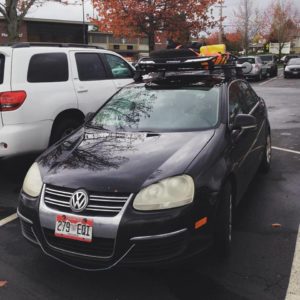
UPDATE: I sold the jetta at 273k miles. I currently exist comfortably without a car. I have an ORCA card and a bike and a smart phone with apps and these haven’t failed me yet. I expect to own cars again, but this time with a “cattle, not pets” approach.
I drive a car with 265k miles on it. It’s a 2006 VW Jetta with a diesel engine and a mostly-functioning turbo and I make emotional decisions about whether to fix it when it breaks. So far I have opted to fix it.
I keep choosing to fix a car that has so many miles on it mostly by convincing myself that it’s a mobile learning lab. That somehow, the time and money I put into the repair will be energy well-spent. I fix it not despite the expense, mental uncertainty, time invested, and inevitable mess, but rather because of it.
There’s a book that I’m rather fond of, titled Shop Class as Soul Craft, and it covers a lot of the philosophy behind putting ones-self through the experience of a complicated repair. It’s very humbling to work on things that are outside of yourself. As he puts it, you have the opportunity to be black-and-white, wrong or right in one’s fix. There’s no weaseling out of it- you can’t argue that you were right about a fix when you very obviously were not. You car can’t be both fixed and also not start. On the other hand, when the car does start, you own that success, and no amount of criticism can steal it from you.
When things go wrong on the car I plan on posting about them here. Car ownership is a finicky thing, but in the United States (outside of big cities) it’s almost a necessity. As a result, fixing cars and “talking shop” are basic survival skills. You’re either going to fix it yourself, or pay for a. having someone else do the work or b. a car that doesn’t break down (the process engineer in me prefers this option, but then I do own a VW).